

سلام. نام من ورونیکا آسیس است، رابط روابط مشتریان در ویلیام بلکاستون اینترنشنال، یک شرکت مشاورهای بینالمللی که بر چارچوبهای دیپلماتیک، نظامهای پروتکل جهانی و ساختارهای نهادی فرامرزی تمرکز دارد.
The following analysis is academic in nature, is intended for informational purposes only, and should not be construed as legal advice. Today’s topic is:
آیا گذرنامههای دیپلماتیک به شما امکان سفر بدون ویزا را میدهند؟ واقعیت
Diplomatic passports are often treated online as though they create automatic entry privileges. In law and practice, they do not. A diplomatic passport is a travel document issued by a sending state. Visa-free travel depends on the rules of the country you are entering, and diplomatic status depends on whether the receiving state has accepted the traveler in an accredited or otherwise officially recognized capacity.
To answer the question correctly, three different systems must be kept separate. The first is passport issuance by the sending state. The second is visa policy and border control by the receiving state. The third is diplomatic status, which depends on recognition, accreditation, and notification through host-state protocol channels.
The three systems people mix up
The confusion usually comes from treating a diplomatic passport like global access. The passport can signal official travel, but the receiving state still decides whether a visa is required, whether a waiver applies, and what entry conditions remain in force.
That is why the same passport can produce different outcomes in different destinations: one may waive visas, another may require them, and a third may waive only for official visits. The passport is the credential you carry; the waiver, if any, is the destination’s rule.
DISPLAY THIS BELOW IN A NICELY DESIGNED FORMAT:
Passport issuance, visa policy, and diplomatic status
| Legal layer | Controlled by | What it answers | Created by the passport itself? |
|---|---|---|---|
| Passport issuance | ارسال ایالتی | What document the traveler holds | بله |
| Visa policy | Receiving state | Whether entry requires a visa or whether a waiver applies | نه |
| Diplomatic status / accreditation | Receiving state | Whether the traveler has recognized diplomatic or official status | نه |
Where visa-free travel actually comes from
Where diplomatic passport holders receive visa-free entry, that result usually comes from an explicit destination-state policy choice, a bilateral agreement, or a multilateral arrangement. Visa-free travel is negotiated, granted, or recognized by the receiving state; it is not created by the passport booklet itself.
Examples make this clear. The European Union and China provide a short-stay waiver of up to 90 days in any 180-day period for holders of qualifying diplomatic passports and EU laissez-passer, while India and Brazil exempt holders of diplomatic, official, and service passports for short stays (typically up to 90 days) for specified purposes, with separate procedures (subject to notification and host-state approval) applying to longer-term diplomatic or consular assignments. Those examples illustrate the legal mechanism: the waiver arises from a binding agreement or the receiving state’s domestic legal framework, not from the passport itself.
A practical point matters here. Visa waiver is not the same thing as guaranteed entry. Even where a visa is waived, the receiving state can still apply its ordinary entry conditions and can refuse entry if those conditions are not met. The waiver removes one step; it does not remove sovereignty over admission.
Common claim vs correct legal framing
| Common claim | Correct framing |
|---|---|
| A diplomatic passport guarantees visa-free travel. | Visa requirements are set by the receiving state; a waiver applies only if a destination rule or agreement provides it. |
| Visa-free means entry is guaranteed. | Visa waiver removes the visa step but does not eliminate entry conditions or the right to refuse entry. |
| A diplomatic passport creates immunity. | Privileges and immunities depend on host-state recognition and the traveler’s category, not on the passport cover. |
What visa-waiver agreements usually cover
In practice, visa-waiver arrangements for diplomatic passports are usually narrow, conditional, and reciprocal. They often include short-stay duration limits, limits on the types of passports covered, and clear suspension clauses that allow negotiations to reset or visas to be re-imposed if a problem emerges.
Many of these agreements specify that the waiver operates “without prejudice” to matters not covered, meaning that ordinary entry conditions under domestic law continue to apply. That is why a traveler can be visa-exempt and still be refused entry if conditions are not met.
Examples of diplomatic passport waivers
| Example instrument | Passports covered | Typical short-stay rule | Key constraint to verify |
|---|---|---|---|
| EU–China short-stay waiver (diplomatic) | Diplomatic passports / EU laissez-passer | Up to 90 days in any 180-day period | Entry conditions still apply; waiver is limited to short stays |
| India–Brazil visa exemption (diplomatic/official/service) | Diplomatic, official, and service passports | Up to 90 days (official duty or tourism) | Purpose and duration constraints; check for assignment vs visit distinctions |
The opposite scenario: a diplomatic passport, but a visa is still required
The opposite situation also exists. Some destination states still require visas from certain diplomatic passport holders, depending on nationality, passport category, and the receiving state’s current rules. The UK’s Diplomatic Visa Arrangement is a specific visa regime under which certain diplomatic passport holders (including from China, Indonesia, South Africa, Turkey, and Vietnam) must obtain prior entry clearance, typically supported by a Note Verbale from their government. U.S. State Department guidance notes that visa requirements for holders of official or diplomatic (special issuance) passports may differ from those applicable to regular passport holders, depending on the destination state’s rules.
This is why a diplomatic passport should be treated as a category signal, not as a universal travel privilege. The safest approach is verification: check the destination’s visa policy for your passport type and nationality, and confirm whether the trip is treated as official travel or personal travel.
Why accreditation still matters
A second confusion is even more persistent than visas: people think a diplomatic passport creates diplomatic status. It does not. Even where entry is facilitated, entry is not the same thing as diplomatic status.
A person may hold a diplomatic passport and still have no recognized diplomatic status or immunity in the country they are entering unless the receiving state has accepted that person in an accredited or otherwise recognized official capacity. Status depends on whether the receiving state has accepted the person in a recognized category under its diplomatic or consular framework. For postings, accreditation is formal and ongoing and is recorded through protocol registration and notification.
This is consistent with the Vienna Convention on Diplomatic Relations, which establishes that diplomatic relations and permanent missions are based on mutual consent and provides for notification of relevant personnel movements to the receiving state’s Ministry for Foreign Affairs or another agreed ministry. Article 39 of the Vienna Convention on Diplomatic Relations provides that, for a person entitled to privileges and immunities, those protections normally begin when the person enters the receiving State to take up post or, if already present, when the appointment is notified to the Ministry for Foreign Affairs or another agreed ministry, subject to the Convention’s specific provisions.
That is also why an official or diplomatic visa does not itself result in diplomatic status or immunity. A visa is an immigration permission. Immunity is a separate legal protection tied to recognized function and category. The passport may support identification and visa processing, but legal privileges depend on host-state recognition and the category in which the person has been accepted.
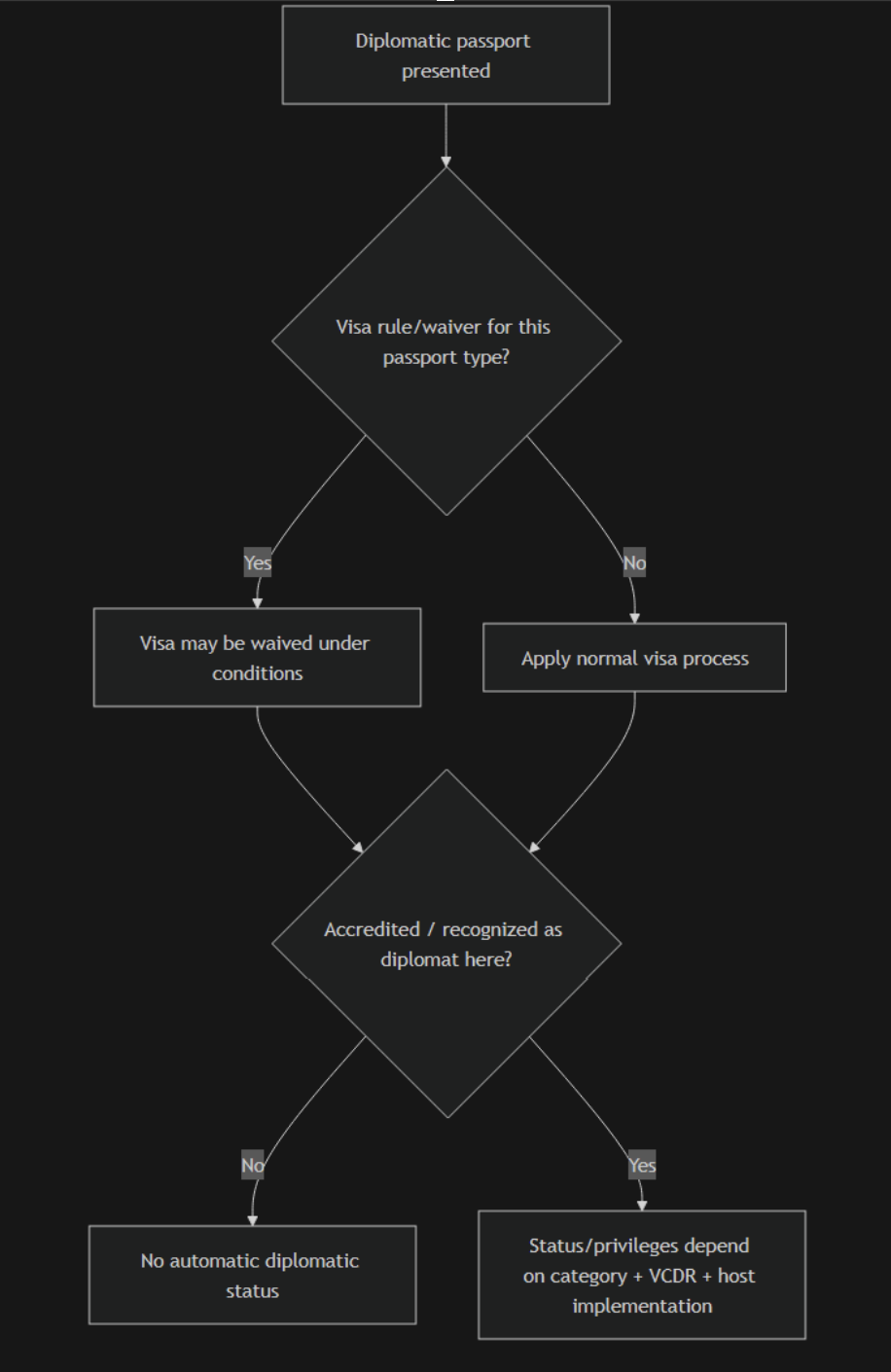
How the decision sequence works (visual)
تصورات غلط رایج
Misconception one is that a diplomatic passport guarantees visa-free entry everywhere. It does not. Visa rules are sovereign border rules and vary by destination, nationality, purpose, and bilateral arrangements.
Misconception two is that an official or diplomatic visa creates diplomatic status. It does not. Status depends on host-state recognition, and it normally requires notification and acceptance through protocol channels.
Misconception three is that the passport booklet itself proves immunity. It does not. Immunity is a legal consequence of recognized role and category, not a feature embedded in the passport cover.
Three questions that resolve most confusion
In practical terms, the cleanest way to analyze any case is to ask three separate questions: what document was issued, what entry rules apply in the destination, and what diplomatic status, if any, has the receiving state recognized.
Once those questions are separated, the confusion around diplomatic passports becomes much easier to resolve. The analysis becomes procedural rather than emotional: identify the credential, identify the border rules that apply to it, and then separately identify whether any diplomatic status has been recognized for that trip or posting.
Three questions and the correct legal focus
| Question | Correct legal focus |
|---|---|
| What document was issued? | Passport type issued by the sending state and its issuance policy |
| What entry rules apply? | Visa policy, waiver agreements, and border rules of the receiving state |
| What status has been recognized? | Accreditation or official recognition by the receiving state through protocol channels |
Practical steps before travel
If the travel is official, confirm whether the destination expects advance notification, diplomatic notes, or protocol coordination. If the travel is personal, confirm whether the diplomatic passport is appropriate for that purpose under the sending state’s own policy.
Before any trip, verify the destination’s visa rules for your passport type and nationality. If a waiver exists, confirm duration and purpose limits. If a visa is required, build time for the correct process rather than assuming the diplomatic passport changes the requirement.
نتیجهگیری کوتاه
So, do diplomatic passports give you visa-free travel? Not automatically.
They can support visa-free entry only when the receiving state’s policy, domestic law, or an applicable bilateral or multilateral arrangement provides for it. But the passport itself is not the legal source of the visa waiver.
And a diplomatic passport is not the legal source of diplomatic status. Status depends on accreditation, recognition, and the receiving state’s legal and protocol framework.
اگر مایلید دیپلماسی را بیشتر بررسی کنید و اولین گام را برای درک نحوه عملکرد عملی سیستمهای دیپلماتیک بینالمللی بردارید، در وبسایت wblackstone.com یک درخواست مشاوره خصوصی ارسال کنید.
[1] [2] https://legal.un.org/ilc/texts/instruments/english/conventions/9_1_1961.pdf
[3] AGREEMENT – between the European Union and the People’s Republic of China on the short-stay visa waiver for holders of diplomatic passports
https://eur-lex.europa.eu/legal-content/EN/TXT/PDF/?uri=CELEX%3A22016A0323%2802%29
[4] https://www.mea.gov.in/Images/CPV/VWA_BRAZIL.pdf
[5] https://www.gov.uk/guidance/diplomatic-visa-arrangement-dva
[6] https://travel.state.gov/content/travel/en/passports/passport-help/after-getting-sia-passport.html