
How to Get a Diplomatic Passport Legitimately in 2026
Academic disclaimer: A análise que se segue é de natureza académica, destina-se apenas a fins informativos e não deve ser interpretada como aconselhamento jurídico.
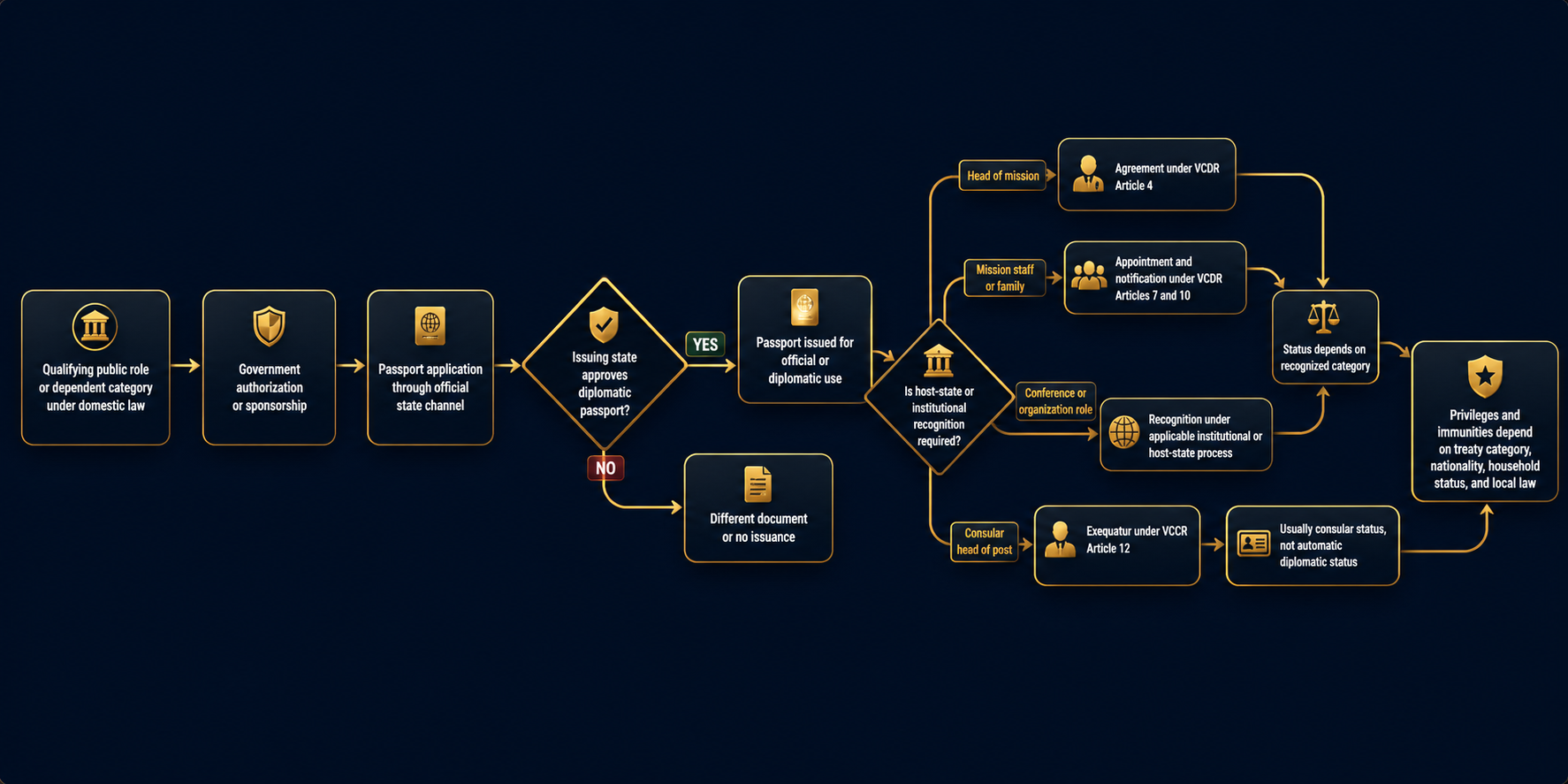
A diplomatic passport is not something a private person simply “applies for” in the ordinary commercial sense. In legitimate systems, the route is public-law based: the issuing state must place the person in a qualifying governmental, diplomatic, consular, delegate, courier, or dependent category under its own rules, and the receiving state or relevant institution may then need to recognize the role for diplomatic status or privileges to exist.
In other words, if someone asks how to get a diplomatic passport, the legally accurate answer begins with the role, not the passport. The passport follows a lawful public function. It does not arise from private brokerage, social status, wealth, or internet offers.
What a Diplomatic Passport Actually Is
A diplomatic passport is a sovereign travel document issued under the domestic law of a state. It is usually connected to official duty, diplomatic assignment, recognized public office, or an authorized dependent relationship.
The Vienna Convention on Diplomatic Relations does not create a category called “person who wants a diplomatic passport.” Instead, it defines diplomatic categories by mission role and status, including heads of mission, diplomatic staff, administrative and technical staff, service staff, and diplomatic agents.
This is why the phrase how to get diplomatic passport can be misleading. The correct question is: what lawful role, appointment, mission, or dependent category would justify issuance under the issuing state’s law?
Diplomatic Passport vs. Diplomatic Status
A diplomatic passport does not automatically create diplomatic status or immunity. This is one of the most important distinctions in diplomatic law.
The passport is issued by the sending state. Diplomatic status, however, often depends on recognition, notification, accreditation, agrément, or another host-state or institutional process.
For example, a proposed head of mission generally requires agrément from the receiving state. Mission staff must be appointed and notified through proper channels. Consular roles may require exequatur under the separate consular framework.
Legitimate Pathways to a Diplomatic Passport
1. Career Diplomatic Service
The clearest route is entering a state’s foreign service or diplomatic service and receiving an overseas assignment that qualifies under domestic passport rules. In the United States, for example, diplomatic passports may be issued to Foreign Service Officers and persons with diplomatic or comparable status traveling abroad on diplomatic duties.
2. Political or Non-Career Appointment
Some states appoint ambassadors, ambassadors at large, or special representatives from outside the permanent career diplomatic service. These appointments can be legitimate, but the legal basis is the formal state appointment, not personal prominence or private influence.
3. Special Envoy, Delegate, or International Mission
Some governments authorize diplomatic passports for official delegates, special envoys, representatives to international organizations, or persons assigned to diplomatic-character missions. Canada, for example, publicly recognizes certain delegates and diplomatic couriers within its diplomatic passport eligibility framework.
4. Dependent or Immediate Family Category
In some systems, eligible spouses, dependents, or immediate family members may receive diplomatic or official passports when connected to a qualifying principal officer. This route is derivative. The family member does not qualify independently; eligibility depends on the principal’s official role and the issuing state’s rules.
5. Diplomatic Courier or Equivalent Official Function
Some states issue diplomatic passports to diplomatic couriers or similar official mission personnel. Again, the passport follows the public mission, not the individual’s private preference.
Why Honorary Consuls Are Different
Honorary consuls are often misunderstood in this context. An honorary consul may be a legitimate public representative, but the office is generally consular rather than diplomatic. It typically requires appointment by the sending state and approval by the receiving state, often through an exequatur.
Honorary consulship is not automatically a route to diplomatic status or a diplomatic passport unless the issuing state’s domestic law separately provides for it.
Legal Checkpoints Before Issuance
Before anyone can legitimately obtain a diplomatic passport, several legal questions must be answered:
- Which state is issuing the document?
- What public role, mission, office, or dependent category justifies issuance?
- Is the role diplomatic, consular, official, or merely informal?
- Does the receiving state need to grant agrément, accreditation, notification acceptance, or exequatur?
- Do nationality, residence, or household rules affect the claim?
- Is the travel official or personal?
- Who controls the passport after issuance?
Red Flags and Compliance Risks
A legitimate diplomatic passport cannot be purchased from a private broker. Any offer claiming to “sell” diplomatic status, guarantee immunity, bypass a foreign ministry, or obtain a diplomatic passport through private payment should be treated as a major red flag.
Official passports often remain government property. They may be restricted to official use, may need to be returned after travel, and may be cancelled or refused in cases of misuse.
Most importantly, a diplomatic passport is not a private shield. It does not automatically exempt the bearer from foreign law, border controls, visa rules, or local legal process.
Conclusion: How to Get a Diplomatic Passport Legitimately
The legitimate way to get a diplomatic passport is not to buy one, broker one, or privately negotiate one. It is to qualify under a state’s official rules through a recognized public role, diplomatic mission, government appointment, official delegation, diplomatic courier function, or authorized dependent category.
The honest legal test is simple: lawful issuance, official function, proper authorization, and recognition where required. If any of those elements is missing, the claim should be treated with caution.
If you would like to learn more about how diplomatic frameworks function in reality, please visit our website: https://wblackstone.com.
Quick FAQ: Get a Diplomatic Passport
Can a private person get a diplomatic passport?
Not in the ordinary private sense. A person must qualify under the issuing state’s official rules, usually through a public role, diplomatic mission, government appointment, official delegation, or authorized dependent status.
Posso comprar um passaporte diplomático?
No. A legitimate diplomatic passport is issued by a competent state authority. Claims that diplomatic passports can be purchased privately should be treated as red flags.
Um passaporte diplomático concede imunidade?
Not by itself. Diplomatic immunity depends on recognized legal status and treaty category, not simply on holding a passport booklet.
Um passaporte diplomático garante a isenção de visto?
No. Visa treatment is controlled by the destination state and any applicable visa-waiver agreement. A diplomatic passport does not automatically override border rules.
Can an honorary consul get a diplomatic passport?
Usually, honorary consuls fall under a consular framework, not an automatic diplomatic one. Whether they receive any special passport depends on the issuing state’s domestic law.
What is the safest first step?
Identify the relevant government authority and verify whether your role is an eligible official category. Do not rely on private brokers or informal promises.
Primary Sources
- United Nations: Vienna Convention on Diplomatic Relations
- United Nations: Vienna Convention on Consular Relations
- 22 C.F.R. § 51.3 — Passport Types
- U.S. Department of State: Steps to Get a Special Issuance Passport
- GOV.UK: Diplomatic and Official Service Passports and Observations
- Canada.ca: Who Can Apply for a Special or Diplomatic Passport