什麼是非職業外交護照?

What Is a Non-Career Diplomatic Passport

Executive summary

Understanding the legal weight of a Non-Career Diplomatic Passport is essential for government officials and international travelers alike. In primary treaty and government sources, a non-career diplomatic passport is a descriptive term rather than a formal category of international law. The legal status of an individual depends on their official mission and recognition by the receiving state. It does not depend on the specific document they hold. The 維也納外交關係公約 (1961) categorizes individuals by their specific roles. These roles include heads of mission or diplomatic staff. The treaty does not categorize people by their passport type.

The use of a Non-Career Diplomatic Passport is a common and measurable practice in major governments. In the United States, for example, over 40% of ambassadorial appointees during the first two years of the Trump administration came from outside the Foreign Service, compared to approximately 30% during the Obama administration.

However, data suggests a gap in specialized preparation between career and non-career tracks:

  • Regional Expertise: 86% of career nominees have prior regional experience, compared to only 24% of political appointees.

  • Language Ability: Only 28% of non-career ambassadorial appointees possess relevant language skills for their post, versus 46% of career picks.

  • In-Country Experience: Only 12% of political nominees had prior experience living in their assigned country, compared to 19% of career nominees.

The core legal questions are different: what document the sending state issued, and what official role justified it. A Non-Career Diplomatic Passport is a travel document, not a legal instrument that confers diplomatic immunity; immunity is derived from official accreditation by the receiving state under the Vienna Convention on Diplomatic Relations. [1]

The practical answer, then, is that a non-career diplomatic passport usually means a diplomatic passport issued to someone who is not part of a permanent career foreign service but who nonetheless falls within a lawful issuing-state category-such as a non-career ambassador, a special envoy, an ambassador at large, a qualifying dependent, or another government-authorized representative. Even then, the passport itself does 唔係 create diplomatic status or immunity. The United Kingdom states expressly that accreditation gives the holder diplomatic or official status, not the passport itself, and the U.S. State Department states expressly that a special issuance passport does not provide 治外法权, does not exempt the bearer from foreign law, and does not provide a shield from arrest. (GOV.UK, 外交和官方服務:護照和觀察; U.S. Department of State, 取得特別簽發護照後) [2]

The issuance of diplomatic passports is strictly regulated to maintain the integrity of diplomatic privileges. According to a study by the Migration Policy Institute, over 190 countries currently issue diplomatic passports. However, the criteria for “non-career” holders are facing increased scrutiny to prevent abuse.

Data from the Migration Policy Institute suggests that less than 5% of all diplomatic passports issued globally are held by individuals outside of the traditional career diplomatic corps. This reflects a significant global trend. Most nations are tightening eligibility requirements. They want to ensure that only those on official state business receive associated travel benefits.

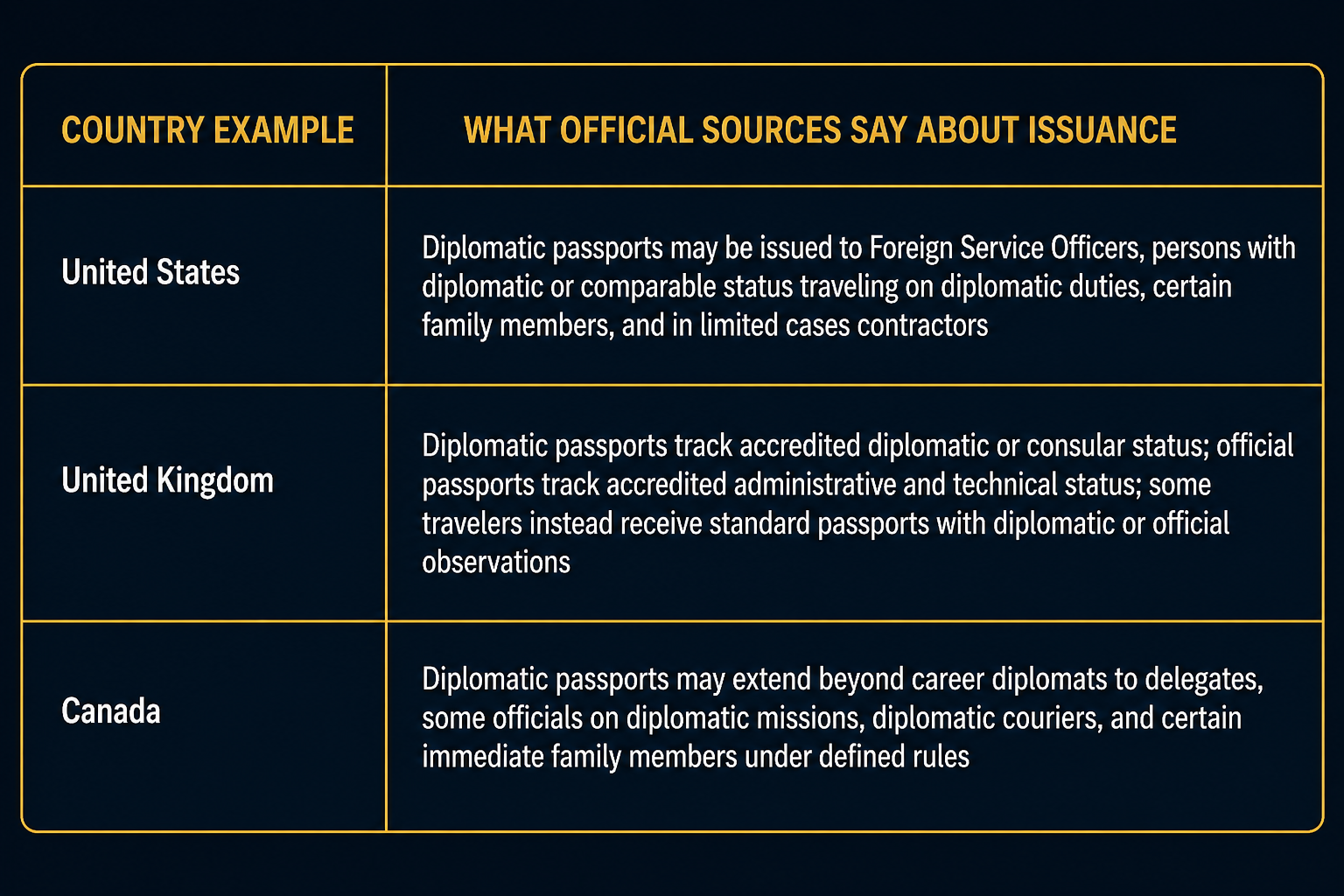
Domestic issuance rules show how much this depends on national law. In the United States, a diplomatic passport is issued to a Foreign Service Officer or a person with diplomatic or comparable status traveling abroad to perform diplomatic duties, with limited family and contractor extensions when the Department authorizes them.

In the United Kingdom, diplomatic passports are tied primarily to accredited diplomatic or consular status, official passports to accredited administrative and technical status. Some travelers instead receive a standard passport containing diplomatic or official observations.

In Canada, diplomatic passports may be issued not only to diplomats and senior officeholders. Also to delegates to diplomatic conferences, some other officials on diplomatic missions, diplomatic couriers, and certain immediate family members under defined conditions. (22 C.F.R. § 51.3; GOV.UK passport guidance; Canada.ca official passport guidance) [3]

The script below is written for narration at a normal pace over roughly ten minutes and mirrors the supplied episodes’ structure: formal disclaimer, treaty-based explanation, visual blocks, and read-aloud lines for each on-screen graphic.

介绍

你好,我是 William Blackstone Internacional 的客戶關係聯絡人 Veronika Asis。.

The following analysis is academic in nature, intended for informational purposes only, and should not be construed as legal advice.

Today’s topic is:

What is a non-career diplomatic passport?

This is a phrase that sounds technical and settled. But in law, it is much less straightforward than it appears. The legally serious answer requires us to separate the passport document, the official role behind it, the receiving state’s recognition. The privileges that international law may or may not attach to that recognized status. (United Nations, 《維也納外交關係公約》; GOV.UK, 外交和官方服務:護照和觀察; U.S. Department of State, 取得特別簽發護照後) [4]

A non-career diplomatic passport is a diplomatic passport issued by a sovereign state to an individual who falls within a domestic legal category entitled to diplomatic documentation for a specific governmental or representational purpose.

Unlike career diplomats who belong to a permanent professional cadre, holders of these documents may include:

  • Non-career ambassadors (political appointees)

  • Special envoys or ambassadors-at-large

  • Delegates to international diplomatic conferences

  • Qualifying dependents or family members of an overseas official

  • Government-authorized contractors or couriers on specific missions

Domestic issuance rules vary significantly by country. For example, in the 美國, 22 C.F.R. § 51.3 governs the issuance of diplomatic passports to those with diplomatic status or those performing diplomatic duties [3]. In 加拿大, these documents may be issued to diplomatic couriers and certain immediate family members under specific conditions.

Defining the Non-Career Diplomatic Passport

A careful definition is this: a non-career diplomatic passport is usually a diplomatic passport issued by a sovereign state to a person who is not necessarily a member of that state’s permanent career diplomatic service, but who falls within a domestic legal category that the issuing state treats as entitled to diplomatic travel documentation for a governmental or representational purpose. That purpose might be a diplomatic appointment, a temporary diplomatic assignment, a special envoy role, a delegate function, a courier function, or-depending on the state’s own rules-a dependent or family status connected to an overseas posting. (22 C.F.R. § 51.3; Canada.ca, Who can apply and who can renew; GOV.UK, 外交和官方服務:護照和觀察) [5]

According to the U.S. Department of State Foreign Affairs Manual (7 FAM 1300), these are classified as “Special Issuance Passports.” The manual clarifies that issuance is based strictly on the nature of the mission and the bearer’s official capacity, rather than their career status.

Furthermore, the legal trigger for immunity is not the document itself, but the process of accreditation. As noted in the UK Government Guidance on Diplomatic and Consular Missions, the Note Verbale process is what establishes legal status. This is codified in Article 39 of the Vienna Convention on Diplomatic Relations (1961), which states that privileges and immunities only begin the moment a person enters the territory of the receiving state to take up their post.

The phrase matters because it often compresses several different legal questions into one misleading label. First, passport issuance is governed by the law and policy of the sending state. Second, status in the host country depends on recognition, notification, accreditation, or other host-state acceptance. Third, privileges and immunities depend on the recognized category under treaty law and local implementation. Fourth, entry treatment still belongs to the destination state, which can apply its own visa and border rules even when the traveler carries a diplomatic passport.
(United Nations, 《維也納外交關係公約》, arts. 4, 10, 31, 37, 39; U.S. Department of State, Visas for Diplomats and Foreign Government Officials; U.S. Department of State, 取得特別簽發護照後) [6]

That is why a diplomatic passport is never the end of the analysis. The most it tells you by itself is that the issuing state has placed the bearer in a document category that its own law recognizes. It does not, on its own, prove that another state must accept the bearer as a diplomat, waive visas, grant immunity, or ignore local law.

A Non-Career Diplomatic Passport is a travel document issued to individuals who are not part of a permanent professional diplomatic cadre. According to the U.S. Department of State Foreign Affairs Manual (3 FAM 2234.3), these appointments are often based on the specific nature of a mission or the bearer’s official capacity. In the United Kingdom, the Foreign, Commonwealth & Development Office (FCDO) is the department responsible for setting the policy on the issuance of these diplomatic and official passports.

The United Kingdom says this directly: accreditation gives the holder diplomatic or official status in-country, not the passport itself. The United States says it directly as well: a special issuance passport does not provide diplomatic immunity and does not exempt the bearer from foreign laws, including immigration and customs laws. (GOV.UK, 外交和官方服務:護照和觀察; U.S. Department of State, 取得特別簽發護照後) [7]

Treaty context under the Vienna Convention

The treaty foundation begins with the purpose of diplomatic privileges and immunities. The preamble to the Vienna Convention on Diplomatic Relations states that privileges and immunities exist not to benefit individuals personally. To ensure the efficient performance of diplomatic missions as representatives of states. That purpose statement is essential, because it tells us immediately why a passport booklet cannot be treated as a private asset or personal shield. (United Nations, 《維也納外交關係公約》, preamble) [8]

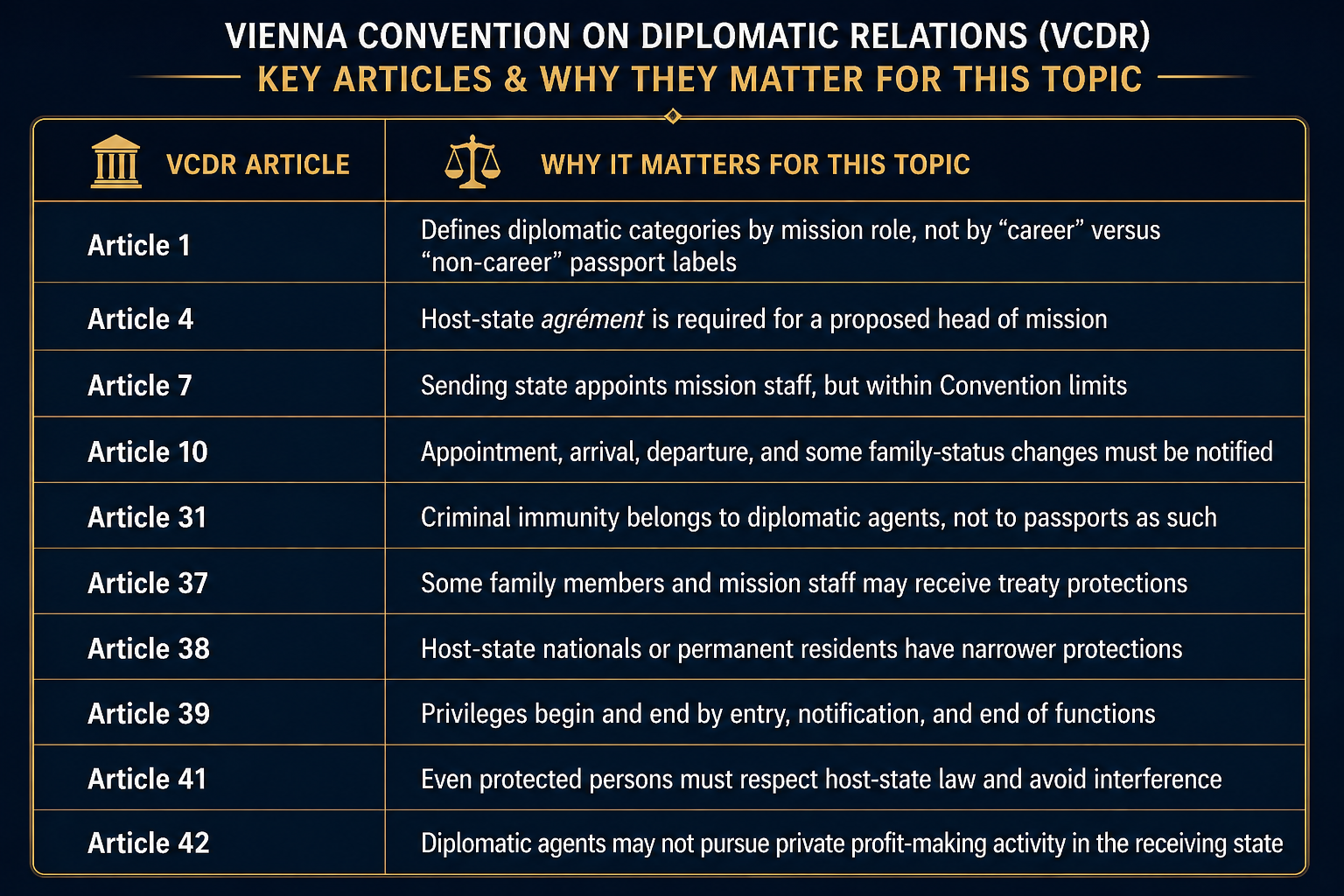
The Convention also shows that diplomatic law is organized around functions and roles, not around the phrase “non-career diplomatic passport.” Article 1 defines the head of mission, members of the mission, diplomatic staff, administrative and technical staff, service staff. “diplomatic agent,” with “diplomatic agent” meaning the head of mission or a member of the diplomatic staff.

Article 4 requires the receiving state’s agrément for a proposed head of mission. Article 7 says the sending state may freely appoint mission staff, but subject to other Convention provisions. Article 10 requires notification of appointments, arrivals, departures, and certain family-status changes to the receiving state’s foreign ministry. (United Nations, 《維也納外交關係公約》, arts. 1, 4, 7, 10) [9]

For privileges and immunities, Article 31 gives diplomatic agents immunity from the criminal jurisdiction of the receiving state, with carefully defined limits for civil and administrative matters.
Article 37 extends specified privileges and immunities to qualifying family members of diplomatic agents and to administrative and technical staff and their families, subject to nationality and residence rules.
Article 38 narrows privileges for diplomats who are nationals or permanent residents of the receiving state.
Article 39 explains when privileges begin and when they normally end.
Article 41 imposes the continuing duty to respect the laws and regulations of the receiving state and not interfere in its internal affairs.
Article 42 bars a diplomatic agent from practicing a professional or commercial activity for personal profit in the receiving state. (United Nations, 《維也納外交關係公約》, arts. 31, 37, 38, 39, 41, 42) [10]

Seen together, those provisions lead to a disciplined conclusion. The Convention recognizes diplomatic categories by appointment, function, notification, recognition, nationality, and household status. It does not say that whoever carries a diplomatic passport-career or non-career-automatically has diplomatic status. Under the treaty framework, the legally decisive questions are whether the person is within a treaty-recognized category and whether the receiving state has accepted or been notified of the relevant appointment in the required way. (United Nations, 《維也納外交關係公約》, arts. 1, 4, 7, 10, 37, 39) [11]

The legal framework for any non-career diplomatic passport is rooted in the Vienna Convention on Diplomatic Relations (VCDR). The VCDR defines individuals by their role and mission status—such as “head of mission” or “diplomatic staff”—rather than by the specific label of their passport. Under this treaty, the legally decisive factor is whether the receiving state has been notified of the appointment and has accepted the individual in a recognized capacity.

ChatGPT Image Apr 28, 2026, 10_56_34 PM.png

The table above is a compact operational reading of the treaty text. (United Nations, 《維也納外交關係公約》, arts. 1, 4, 7, 10, 31, 37, 38, 39, 41, 42) [12]

Issuance rules in the United States the United Kingdom and Canada

The clearest proof that “non-career diplomatic passport” is really a domestic-law question is the variation in national issuance rules.

The requirements for obtaining a non-career diplomatic passport depend entirely on the laws of the sending state:

  1. United States: The Department of State issues “Special Issuance Passports.” They explicitly state that these documents do not provide a shield from arrest or exempt the bearer from foreign law unless the bearer is accredited to a specific mission.

  2. United Kingdom:GOV.UK guidance clarifies that accreditation—not the passport—gives the holder diplomatic status. Some travelers receive standard passports with “diplomatic observations” instead of a separate booklet.

  3. Canada: Issuance is extended to senior officeholders, delegates to conferences, and officials on diplomatic missions, provided they meet the criteria set by Global Affairs Canada.

In the United States, 22 C.F.R. § 51.3 states that a diplomatic passport is issued to a Foreign Service Officer or to a person having diplomatic status or comparable status because the person is traveling abroad to carry out diplomatic duties on behalf of the U.S. government. The same regulation allows issuance, when authorized, to spouses and family members of such persons and, in limited circumstances, to a U.S. government contractor whose duties require the document. The State Department’s Special Issuance Agency also says those passports are for official or diplomatic duties for the U.S. government, are not for personal travel except limited assignment-related movement, remain U.S. government property, and must be returned.

Issuance rules vary significantly by country. In the 美國, the Department of State restricts these documents to Foreign Service Officers and those with specific diplomatic status. Under 22 CFR § 51.3, diplomatic passports are reserved for those performing diplomatic duties abroad [5].

The U.S. government may extend these privileges to certain contractors or family members. However, these are rare exceptions. They are authorized by specific policy rather than a universal right. The Foreign Affairs Manual (8 FAM 503.2) outlines these strict eligibility requirements to prevent the dilution of the document’s prestige. (22 C.F.R. § 51.3; U.S. Department of State, 取得特別簽發護照後) [13]

In the United Kingdom, HM Passport Office guidance explains that diplomatic or official accreditation is governed by the Vienna Convention framework and that accreditation-rather than the passport itself-gives the holder diplomatic or official status in the host country. The same guidance says that UK government staff and their dependents who are accredited with diplomatic or consular status are entitled to hold a diplomatic passport. Those with administrative and technical status are entitled to hold an official passport. It also recognizes a separate device-a standard passport with diplomatic or official observations-for some travelers who are on diplomatic or official business but are not accredited, are abroad only briefly, cannot wait for a diplomatic or official passport, or are traveling to a politically sensitive area.

The 2024 FCDO statement adds that the UK maintains a fundamental link between diplomatic or official passports and accreditation, while creating limited exceptions for certain spouses and partners. The same statement says ministers and other parliamentarians remain generally ineligible, except for narrow facilitation cases tied to restrictive visa regimes. (GOV.UK, 外交和官方服務:護照和觀察; UK Parliament/FCDO, Diplomatic Passport Policy statement) [14]

In Canada, official travel guidance states that a special or diplomatic passport tells border officials that the bearer is traveling on official business and representing Canada abroad. Canada’s eligibility rules are broader than a simple “career diplomat only” model. They include ambassadors, ministers, high commissioners, officers of diplomatic rank, attachés, trade commissioners, consular officers, representatives and delegates to international governmental organizations and diplomatic conferences, other government employees abroad on a diplomatic mission, private citizens nominated as official delegates to diplomatic conferences, diplomatic couriers. Certain immediate family members traveling with or joining the principal abroad.

Canada also distinguishes a diplomatic passport from a special passport, the latter being used for various non-diplomatic official categories. Canada further states that an official passport must be used for official business. In most other situations the traveler must use a regular blue passport. The passport remains government property, that misuse can lead to cancellation or refusal of future issuance, that the passport must usually be returned after travel, and that under the administrative version of the Diplomatic and Special Passports Order the document automatically ceases to be valid when the underlying duty ends. (Canada.ca, About official passports; Who can apply and who can renew; When to apply and how to use it; After you apply; Types of passports and other travel documents) [15]

The comparative lesson is straightforward: national law decides who may receive a diplomatic passport, how that passport may be used, whether dependents are included. When the document must be returned or ceases to be valid. That is why “non-career diplomatic passport” cannot be answered globally with a single sentence. It is a category-shaped question whose content changes from one issuing state to another. (22 C.F.R. § 51.3; GOV.UK passport guidance; Canada.ca official passport guidance) [16]

Passport versus diplomatic status immunity and common non-career categories

A common myth is that holding a non-career diplomatic passport provides “blanket immunity.” This is legally incorrect.

  • Accreditation is Key: Immunity is generally only active in the country where the bearer is formally accredited.

  • Functional Necessity: Privileges exist to ensure the “efficient performance of diplomatic missions,” not for personal benefit.

  • Respect for Local Law: Article 41 of the VCDR mandates that all persons enjoying privileges must still respect the laws and regulations of the receiving state.

The most important legal distinction is the one between passport and status. Official UK guidance says that accreditation gives the holder diplomatic or official status and not the passport itself. Official U.S. guidance says a special issuance passport does not provide diplomatic immunity, does not exempt the bearer from foreign law, and does not shield the bearer from arrest. Those statements are unusually clear, and they align exactly with the Vienna Convention’s structure. (GOV.UK, 外交和官方服務:護照和觀察; U.S. Department of State, 取得特別簽發護照後; 聯合國、, 《維也納外交關係公約》, arts. 31, 39, 41) [17]

Host states also control entry categories. The U.S. visa guidance for foreign diplomats and government officials states that those coming to the United States to engage solely in official duties for their national government must obtain A-1 or A-2 visas. Position and purpose determine which visa is required, and that a person carrying a diplomatic passport as a tourist generally needs the visa category appropriate to tourism unless the limited head-of-state rule applies. That is another official illustration that a diplomatic passport, by itself, does not settle entry or legal status questions. (U.S. Department of State, Visas for Diplomats and Foreign Government Officials; U.S. Department of State, FAQs for Foreign Government Officials) [18]

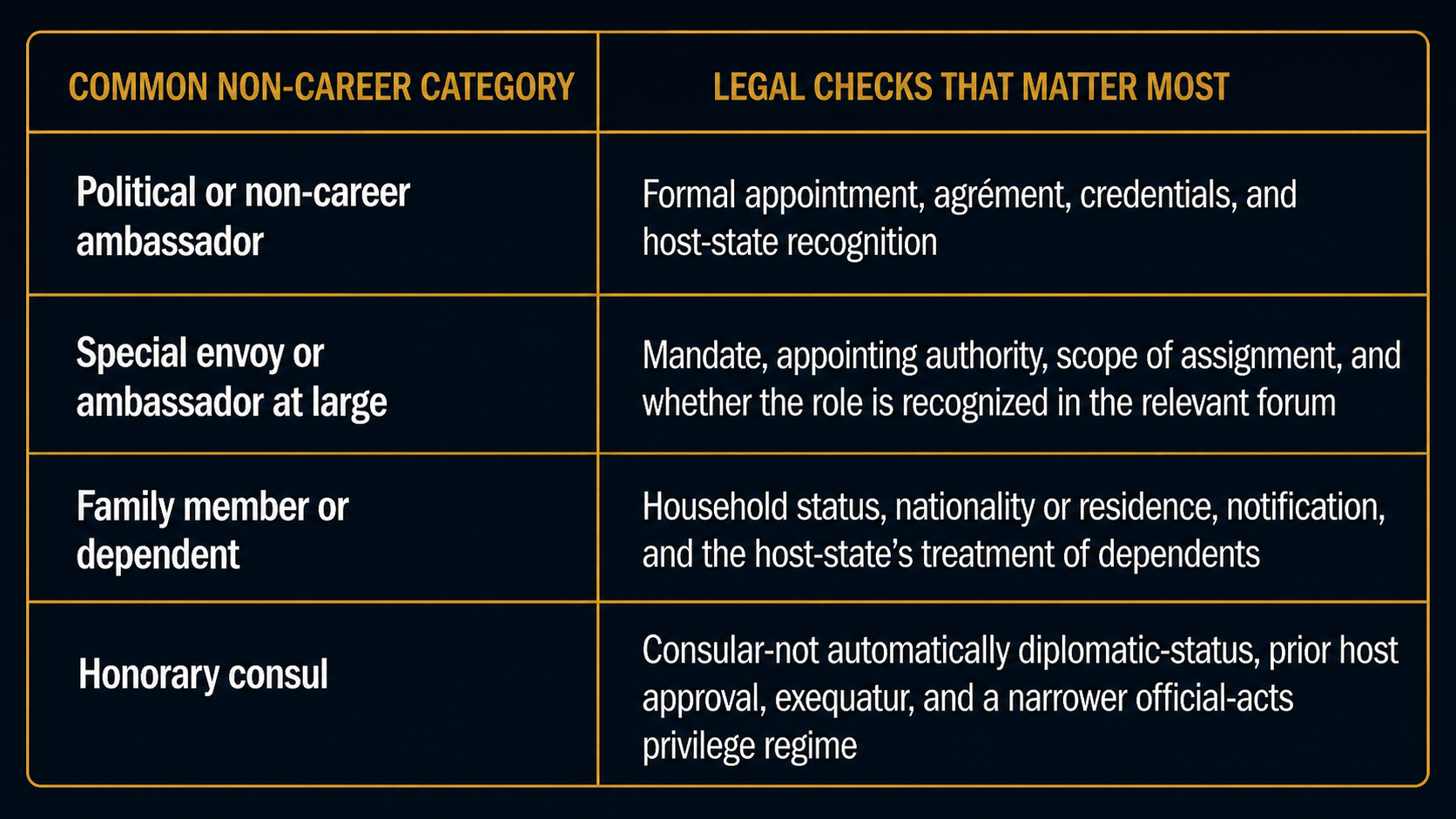
Within that framework, several recurring non-career or non-regular categories appear in practice. One is the political or non-career ambassador. In the U.S. historical record, the State Department’s Office of the Historian identifies some chiefs of mission as “non-career appointee.” Another is the ambassador at large or special diplomatic envoy. The Office of the Historian explains that Presidents have long designated special diplomatic envoys for specific assignments and have usually appointed ambassadors at large for specified foreign-policy issues. The State Department likewise describes the Special Presidential Envoy for Hostage Affairs as a senior diplomat with the rank of ambassador appointed by the President.

These official sources show that a state can create diplomatic roles outside a normal resident embassy ladder. They do not show that the passport, by itself, establishes full host-state diplomatic status. That still depends on the role, the assignment, and the receiving state’s recognition where recognition is required. (U.S. Department of State, Office of the Historian, Kyle McCarter; Office of the Historian, 無任所大使; U.S. Department of State, Your U.S. Government Team / search snippet for SPEHA) [19]

A third category is the family member or dependent. The treaty text matters here. Article 37 of the VCDR extends privileges and immunities to qualifying family members of a diplomatic agent who form part of the household and are not nationals of the receiving state. Article 10 also requires notification of arrivals, departures, and family-status changes. Domestic passport rules in the U.S., UK, and Canada likewise show that spouses, children, and other dependents may in some circumstances receive diplomatic or official travel documents. But family eligibility for a passport is still not identical to full, independent diplomatic rank.

The legal effect depends on the treaty category, household status, nationality or permanent residence, and host-state recognition or notification. (United Nations, 《維也納外交關係公約》, arts. 10, 37, 38; 22 C.F.R. § 51.3; GOV.UK passport guidance; Canada.ca official passport guidance) [20]

A fourth category is the honorary consul, and this is where confusion is especially common. Honorary consuls are ordinarily consular, not diplomatic, actors. Under the Vienna Convention on Consular Relations, honorary consular officers fall under a separate Chapter III regime. Canada’s Office of Protocol says foreign states must seek Canada’s approval before appointing or reappointing an honorary consul. Honorary consuls are not self-appointed, and that a valid exequatur is required for the office to continue.

The VCCR further provides that honorary consuls receive the functional regime specified in Article 58. They may still be subject to criminal proceedings under Article 63, and that each state is free under Article 68 to decide whether it will appoint or receive honorary consular officers. Canada states bluntly that honorary consuls have immunity only for official consular acts and are not immune from arrest or detention. So, if someone says “non-career diplomatic passport” but is really describing an honorary consul, the correct legal response is that the person is usually in a distinct consular framework, not the diplomatic one. (United Nations, 維也納領事關係公約, arts. 43, 58, 63, 68; Global Affairs Canada, 任命駐加拿大名譽領事) [21]

United Kingdom government emphasizes that diplomatic status is derived from accreditation. It is not derived from the passport itself. Diplomatic passports are merely travel documents that facilitate official duties.

U.K. Foreign, Commonwealth & Development Office (FCDO) notes that these passports are issued to individuals representing the government abroad. The goal is to ensure they receive appropriate courtesies. However, the legal protection comes from the host country recognizing their specific mission.

A non-career diplomatic passport serves as a vital tool for international representation, but it is not a standalone source of legal power. Whether you are a political appointee or a family member of a diplomat, your legal protections depend on treaty-recognized functions and host-state recognition.

Evaluation of the Privileges and Immunities of a Diplomatic Passport

flow chart.png

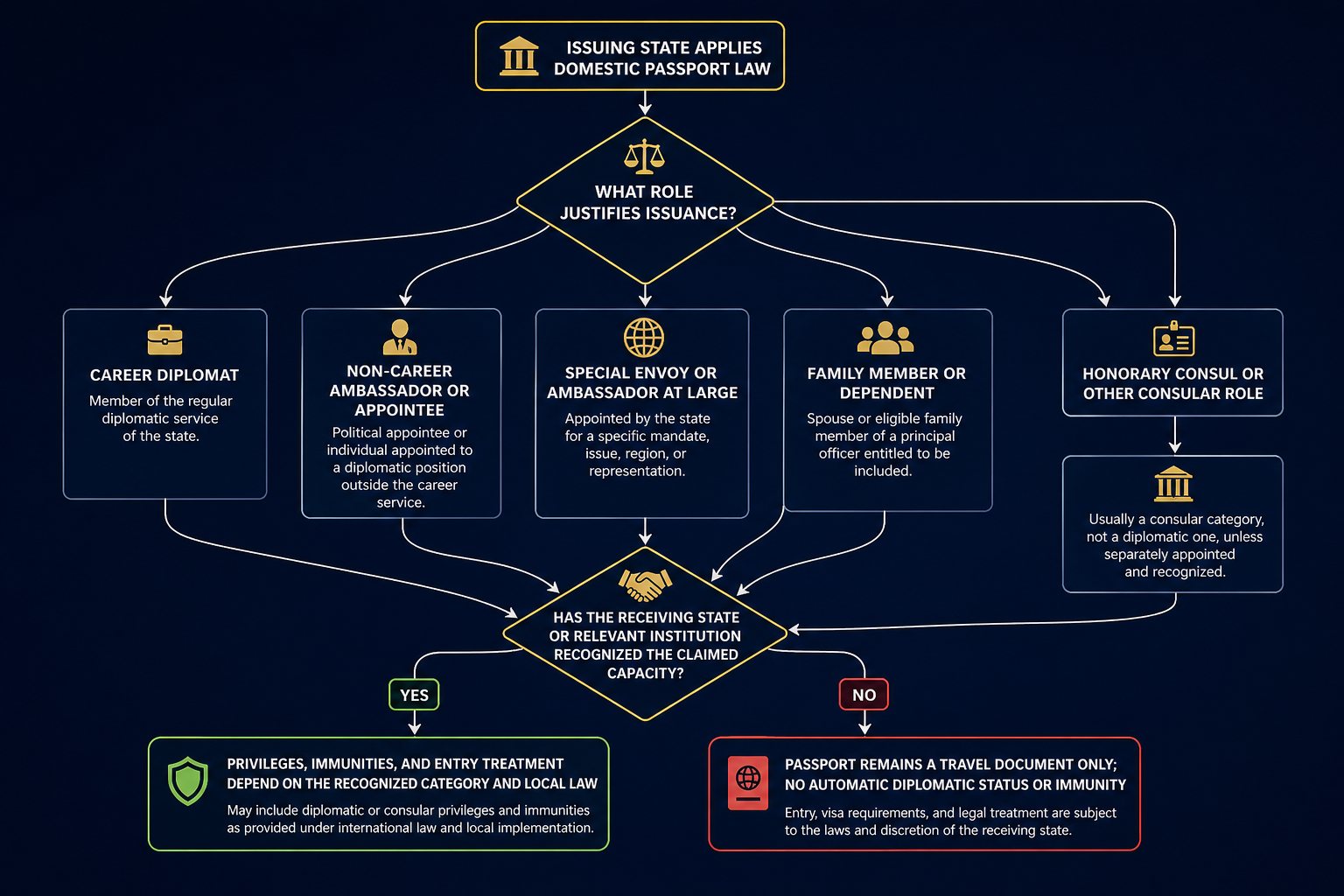
The operational logic can be reduced to a simple sequence: issuance by the sending state, role-based justification, recognition by the receiving state or relevant institution, and only then any applicable privileges. That sequence comes from the combination of VCDR Articles 4, 10, 31, 37, and 39; domestic passport rules in the U.S., UK, and Canada; and, for honorary consuls, the VCCR exequatur and Chapter III rules. (United Nations, 《維也納外交關係公約》; 聯合國、, 維也納領事關係公約; U.S. Department of State; GOV.UK; Canada.ca) [22]

The core mistake is to stop at the passport. The legal process does not stop there. The issuing state decides whether the person qualifies for a diplomatic or official document. The next question is what role justified that decision. After that comes recognition by the receiving state, or by the relevant international institution if the role is tied to one. Only after those steps do privileges or immunities become a serious legal question. If recognition never happens, the passport usually remains what it always was: a state-issued travel document, not a universal shield. (United Nations, 《維也納外交關係公約》; 聯合國、, 維也納領事關係公約; U.S. Department of State; GOV.UK) [23]

ChatGPT Image Apr 28, 2026, 10_59_37 PM.png

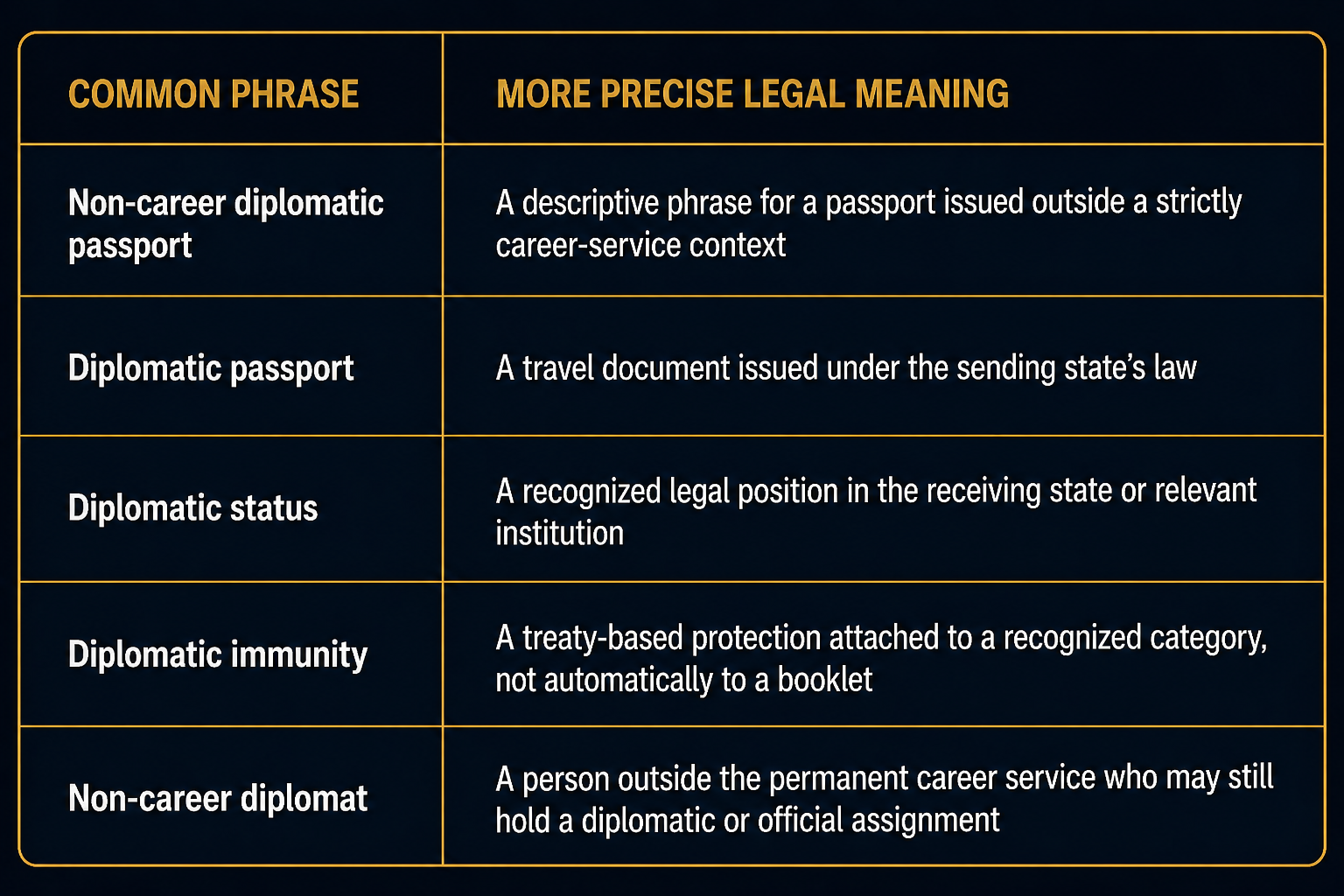
Source basis: VCDR Articles 1, 31, 37, 39; U.S. State Department special issuance guidance; UK passport guidance. [24]

The safest way to understand the term is to separate the document from the status. The passport is issued by one state under its own law. Diplomatic status exists only if the relevant host state or institution recognizes the bearer in a protected legal category. Immunity, where it exists, flows from that recognized category and the governing treaty rules, not from the cover color of the passport itself. (United Nations, 《維也納外交關係公約》; U.S. Department of State; GOV.UK) [24]

ChatGPT Image Apr 28, 2026, 11_00_44 PM.png

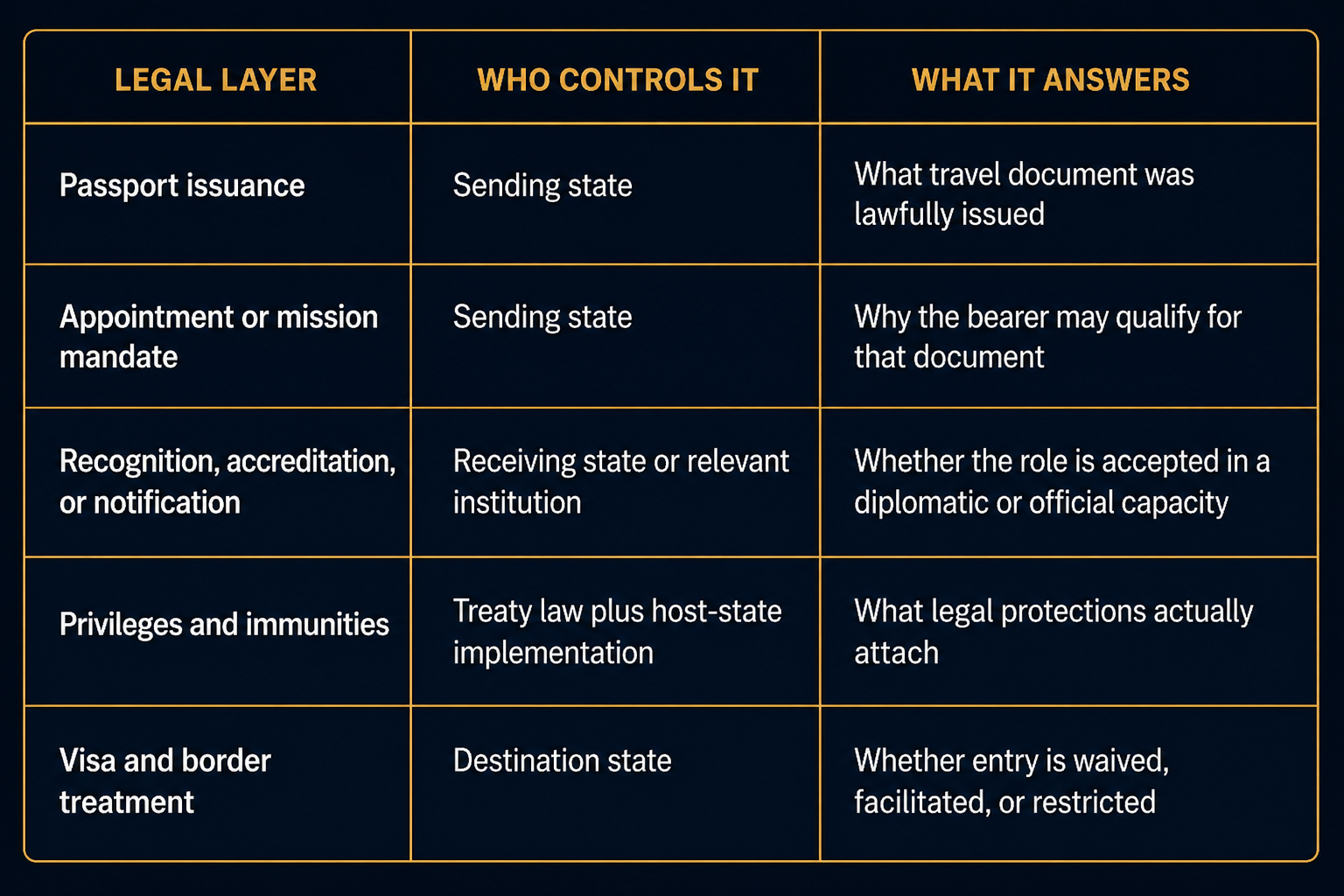
Source basis: VCDR Articles 4, 10, 31, 37, 39; U.S. inbound visa guidance; UK and Canada passport guidance. [25]

A great deal of confusion disappears once these layers are kept separate. The sending state decides whether it will issue a diplomatic or official passport. The receiving state decides whether the person is recognized in a diplomatic or comparable role. Treaty law and local implementation then determine the scope of any privileges. And border authorities still apply their own entry rules. One booklet does not control all four questions. (United Nations, 《維也納外交關係公約》; U.S. Department of State; GOV.UK) [26]

Diplomatic passports may be issued to Foreign Service Officers, persons with diplomatic or comparable status traveling on diplomatic duties, certain family members, and in limited cases contractors

ChatGPT Image Apr 28, 2026, 11_02_01 PM.png

英國

In the United Kingdom, the type of travel document issued reflects the holder’s accredited status rather than a single universal category. Diplomatic passports are tied to accredited diplomatic or consular status, official passports to accredited administrative and technical status, and some travelers instead receive a standard passport containing diplomatic or official observations. This structure means that what might elsewhere be described as a non-career diplomatic passport—a document issued to someone outside the permanent career foreign service for a specific governmental or representational purpose—may in the UK context take the form of a diplomatic passport, an official passport, or a standard passport with observations, depending on the nature and duration of the holder’s accredited role. Crucially, the UK government states expressly that it is accreditation, not the passport itself, that confers diplomatic or official status in-country.

加拿大

Diplomatic passports may extend beyond career diplomats to delegates, some officials on diplomatic missions, diplomatic couriers, and certain immediate family members under defined rules

Source basis: 22 C.F.R. § 51.3; GOV.UK passport guidance and 2024 FCDO statement; Canada.ca official passport pages and passport types page. [27]

The phrase “non-career diplomatic passport” only makes sense when you look at the issuing state’s own rules. In the United States, the law expressly allows diplomatic passports for some people who are not simply career Foreign Service officers. In the United Kingdom, the system is tightly linked to accreditation status and also uses official passports and standard passports with observations. In Canada, the eligible group includes not only diplomats but also delegates, couriers, and some family members. So the document category is always a domestic-law question first. (22 C.F.R. § 51.3; GOV.UK passport guidance; Canada.ca official passport guidance) [3]

ChatGPT Image Apr 28, 2026, 11_03_07 PM.png

Source basis: VCDR Articles 4, 10, 37, 38, 39; VCCR Articles 12, 43, 58, 63, 68; U.S. State Department historical pages; Global Affairs Canada honorary consul guidance. [28]

This is where the analysis has to stay disciplined. A non-career ambassador is not the same thing as a special envoy. A dependent is not the same thing as an honorary consul. And an honorary consul is usually not in the diplomatic regime at all, but in the consular one. The legal checks change with the category. That is why serious assessment always begins with the appointing authority, the purpose of the role, and the form of host-state acceptance. (United Nations, 《維也納外交關係公約》; 聯合國、, 維也納領事關係公約; Global Affairs Canada; U.S. Department of State historical pages) [28]

ChatGPT Image Apr 29, 2026, 10_56_34 PM.png

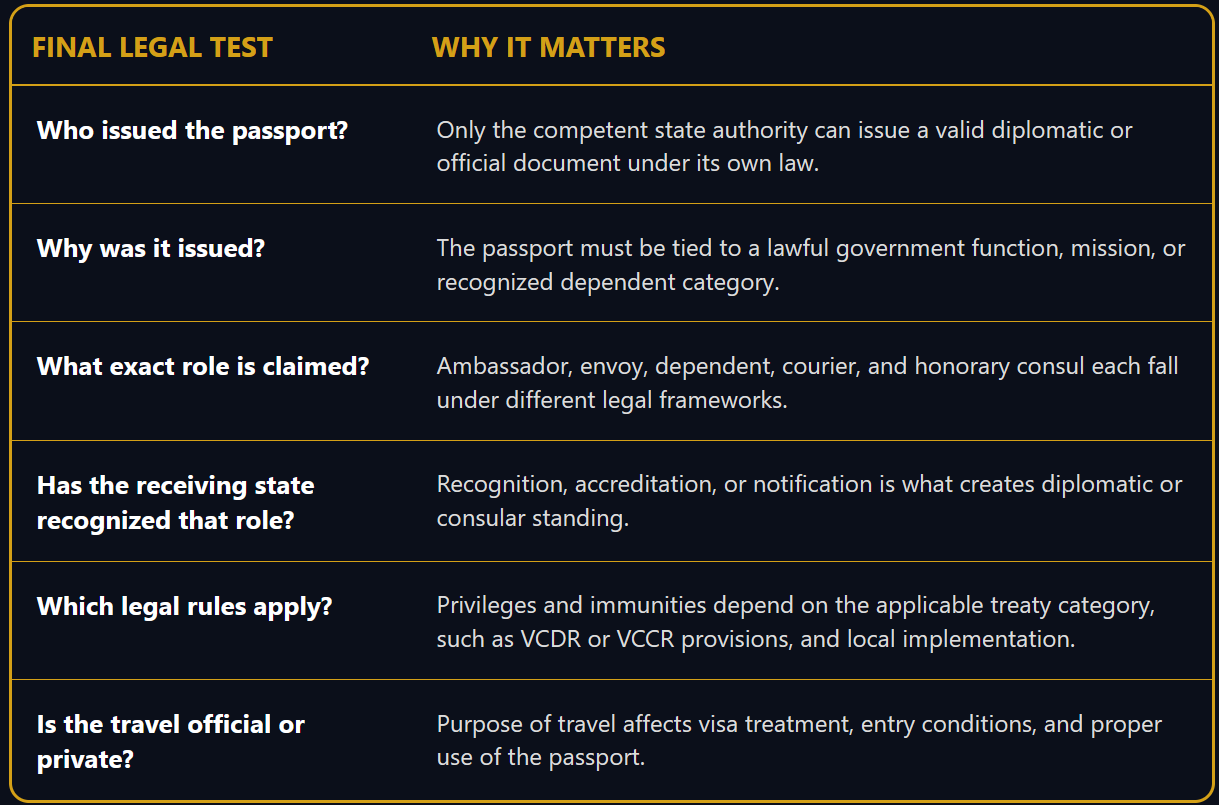
Source basis: VCDR Articles 1, 4, 10, 31, 37, 39, 41, 42; VCCR Articles 12, 43, 58, 63, 68; U.S. State Department; GOV.UK; Canada.ca. [29]

These are the questions that prevent wishful thinking. Who issued the document, and under what legal authority? What role actually justified the issuance? Was that role recognized by the place where the person is traveling or serving? Which treaty rules apply to that recognized category? And is the trip official or private? Once those questions are asked in order, the phrase “non-career diplomatic passport” becomes much less mysterious-and much less vulnerable to abuse. (United Nations, 《維也納外交關係公約》; 聯合國、, 維也納領事關係公約; U.S. Department of State; GOV.UK; Canada.ca) [29]

Final legal test compliance risks and primary sources consulted

The short compliance answer is that a non-career diplomatic passport, like any diplomatic or official document, is a state instrument rather than a private asset. U.S. guidance specifies that a special issuance passport is for official or diplomatic duties, is not generally for personal travel, remains government property, and must be returned. Canadian guidance similarly mandates that official passports be used only for official business, remain government property, and may be cancelled or refused if misused. UK guidance likewise distinguishes these documents from standard passports used for personal travel. (U.S. Department of State, After You Get Your Special Issuance Passport; Canada.ca, When to apply and how to use it; Canada.ca, After you apply; GOV.UK, Diplomatic and official service: passports and observations) [30] There is also a recognition risk. Under the VCDR, a receiving state may refuse agrément for a proposed head of mission and may later declare a diplomat persona non grata. Under the VCCR, a receiving state may refuse an exequatur for a consular head of post or cease to consider a person a member of the consular staff. Consequently, even when the sending state has issued a diplomatic document, the host state retains control over whether the bearer is accepted in the claimed diplomatic or consular role. (United Nations, Vienna Convention on Diplomatic Relations, arts. 4, 9; United Nations, Vienna Convention on Consular Relations, arts. 12, 23) [31] Finally, there is a conduct risk. The treaty rule is not one of privilege without restraint. VCDR Article 41 requires respect for the receiving state’s laws and forbids interference in internal affairs, while VCDR Article 42 bars personal-profit professional or commercial activity by diplomatic agents. VCCR Article 55 imposes the same basic duty of law-respect and non-interference in the consular context. Canada’s honorary-consul guidance illustrates how modern states operationalize these concerns by requiring criminal-record and conduct-related declarations before appointment and by monitoring conflicts that may become incompatible with the office. Holders of any diplomatic passport are subject to these same obligations and remain accountable under both the sending state’s domestic law and the treaty framework governing their recognized role. (United Nations, Vienna Convention on Diplomatic Relations, arts. 41, 42; United Nations, Vienna Convention on Consular Relations, art. 55; Global Affairs Canada, Appointing an honorary consul in Canada) [32]

So, what is a non-career diplomatic passport?

The most careful answer is this: it is usually a diplomatic passport issued under national law to a person who is not necessarily part of the permanent career diplomatic service, but who has some recognized governmental basis for receiving that document. That basis might be an ambassadorial appointment, a special diplomatic mandate, a delegate function, a courier role, or a qualifying dependent status. But the passport alone does not create diplomatic status, does not itself create immunity, and does not displace the host state’s power over recognition, visas, or local law. (United Nations, 《維也納外交關係公約》; U.S. Department of State; GOV.UK; Canada.ca) [33]

If you would like to explore diplomacy further and take a first step into understanding how international diplomatic systems function in practice, visit us at wblackstone.com.

Primary sources consulted for reverification: United Nations treaty text of the 《維也納外交關係公約》 and the 維也納領事關係公約; U.S. Department of State special issuance passport guidance and visa guidance for diplomats and foreign officials; 22 C.F.R. § 51.3; HM Passport Office and FCDO guidance on diplomatic and official passports; Canada.ca official travel and diplomatic/special passport guidance; and Global Affairs Canada protocol guidance on honorary consuls. [34]

結論

Ultimately, a Non-Career Diplomatic Passport serves as a travel document for official missions, but it is not a universal shield. Legal protection depends on treaty-defined roles and host-country recognition.

Final legal test compliance risks and primary sources consulted

When conducting a final legal test of a Non-Career Diplomatic Passport, the primary compliance risk is the “immunity gap.” Bearers often mistakenly believe the document provides a shield from arrest, but without formal accreditation, they remain subject to local laws.

The primary sources consulted for this analysis include the Vienna Convention on Diplomatic Relations (1961), the U.S. Department of State Foreign Affairs Manual (FAM), and official guidance from the UK Foreign, Commonwealth & Development Office (FCDO). These sources confirm that the Non-Career Diplomatic Passport serves as a request for passage, but the legal status of the individual is determined by the host state’s recognition of their official mission.

常見問題

  • Does a non-career diplomatic passport grant automatic immunity? No. Under the Vienna Convention, immunity is tied to your official role and accreditation by the host country, not the passport document itself.

  • Who qualifies for a non-career diplomatic passport? Eligibility varies by country but typically includes political appointees, special envoys, and qualifying dependents of diplomats.

  • Is a non-career diplomatic passport the same as a “Special Issuance Passport”? Yes, in the United States, the State Department categorizes these under the umbrella of Special Issuance Passports.


[1] [4] [6] [8] [9] [10] [11] [12] [20] [22] [23] [24] [25] [26] [28] [29] [31] [32] [33] [34] https://legal.un.org/ilc/texts/instruments/english/conventions/9\_1\_1961.pdf

https://legal.un.org/ilc/texts/instruments/english/conventions/9_1_1961.pdf

[2] [7] [14] [17] https://www.gov.uk/government/publications/diplomatic-and-official-service-passports-and-observations/diplomatic-and-official-service-passports-and-observations-accessible

https://www.gov.uk/government/publications/diplomatic-and-official-service-passports-and-observations/diplomatic-and-official-service-passports-and-observations-accessible

[3] [5] [13] [16] [27] https://www.ecfr.gov/current/title-22/chapter-I/subchapter-F/part-51/subpart-A/section-51.3

https://www.ecfr.gov/current/title-22/chapter-I/subchapter-F/part-51/subpart-A/section-51.3

[15] https://www.canada.ca/en/immigration-refugees-citizenship/services/canadian-passports/official-travel/special-diplomatic-adults.html

https://www.canada.ca/en/immigration-refugees-citizenship/services/canadian-passports/official-travel/special-diplomatic-adults.html

[18] https://travel.state.gov/content/travel/en/us-visas/other-visa-categories/visas-diplomats.html

https://travel.state.gov/content/travel/en/us-visas/other-visa-categories/visas-diplomats.html

[19] https://history.state.gov/departmenthistory/people/mccarter-kyle

https://history.state.gov/departmenthistory/people/mccarter-kyle

[21] https://legal.un.org/ilc/texts/instruments/english/conventions/9\_2\_1963.pdf

https://legal.un.org/ilc/texts/instruments/english/conventions/9_2_1963.pdf

[30] https://travel.state.gov/content/travel/en/passports/passport-help/after-getting-sia-passport.html

https://travel.state.gov/content/travel/en/passports/passport-help/after-getting-sia-passport.html

Key Takeaways

  • What is a non-career diplomatic passport?

  • Domestic issuance rules show how much this depends on national law.

  • The following analysis is academic in nature, intended for informational purposes only, and should not be construed as legal advice.

  • What is a non-career diplomatic passport?

  • This is a phrase that sounds technical and settled.

常見問題

  • Does a non-career diplomatic passport grant automatic immunity? No. Under the Vienna Convention, immunity is tied to your official role and accreditation by the host country, not the passport document itself.

  • Who qualifies for a non-career diplomatic passport? Eligibility varies by country but typically includes political appointees, special envoys, and qualifying dependents of diplomats.

  • Is a non-career diplomatic passport the same as a “Special Issuance Passport”? Yes, in the United States, the State Department categorizes these under the umbrella of Special Issuance Passports.