The distinction between an honorary consul vs career diplomat is not a matter of prestige or protocol alone — it is a foundational jurisdictional question with direct consequences for legal standing, immunity scope, and the authority by which any representative may act on a foreign state’s behalf. For ultra-high-net-worth individuals, senior political figures, and the private client lawyers and fiduciaries who advise them, understanding this distinction is a prerequisite to evaluating any non-career diplomatic appointment with integrity.
The two roles are governed by separate international instruments, carry materially different protections, and impose distinct obligations on both the appointing state and the individual concerned. A career diplomat operates as a full-time civil servant under the Vienna Convention on Diplomatic Relations (1961), with broad immunity and national jurisdictional reach. An honorary consul — a private citizen appointed on a part-time, non-salaried basis — operates under the narrower framework of the Vienna Convention on Consular Relations (1963), with immunity from jurisdiction generally tied to official consular acts and other protections governed by Chapter III and, where applicable, Article 71.
What follows is a structured jurisdictional analysis of both roles: their legal architecture, immunity constraints, appointment instruments, and the practical implications for any high-profile individual or intermediary assessing alignment between professional standing and official international function. William Blackstone Internacional’s compliance-first approach to non-career diplomatic advisory services — including initial advisory memoranda, jurisdictional analysis, and framework alignment review — begins precisely here, with clarity on what each role does and does not confer under international law.
Honorary Consul vs Career Diplomat: Core Jurisdictional Definitions
The debate around honorary consul vs career diplomat isn’t merely academic — it determines legal standing, the scope of official protection, and the authority by which a representative may act on a foreign state’s behalf. Understanding these distinctions is crucial, whether you’re navigating consular services, verifying credentials, or evaluating non-career diplomatic roles under international law.
Career Diplomat
A full-time member of the sending state’s foreign service, recruited through its domestic appointment procedures. Career diplomats receive salaries, benefits, and operate exclusively within their government’s foreign service apparatus. They owe their allegiance — and their paycheck — entirely to the sending state.
Career diplomats are full-time civil servants of their sending state, whereas honorary consuls are often private citizens who perform their duties on a part-time basis without a salary.
Legal framework:Vienna Convention on Diplomatic Relations (1961) and Vienna Convention on Consular Relations (1963). Recruitment and remuneration depend on domestic rules.
Honorary Consul
A private citizen, often already resident in the host (receiving) state, who performs consular duties on a part-time, non-salaried basis. In The Whitehead Journal of Diplomacy and International Relations (2005), Euripides L. Evriviades describes honorary consuls as a link between an embassy and its citizens abroad, with responsibilities that include assistance to citizens and support for trade and investment. The Vienna Convention on Consular Relations (1963) formally codifies this distinction.
Article 43, applied to honorary consular officers by Article 58, provides immunity from jurisdiction for official consular acts, subject to its stated exceptions. Article 71 specifically addresses consular officers who are nationals or permanent residents of the receiving state; it does not define the position of every honorary consul.
Source: United Nations Treaty Series
The honorary consul also serves as a vital link and liaison between the government’s embassy and its citizens living abroad.
Source:Euripides L. Evriviades, The Whitehead Journal of Diplomacy and International Relations (2005), p. 24.
Functional Immunity
A limited form of legal protection covering only acts performed in an official capacity — the default standard applied to honorary consuls, as opposed to the broader immunity extended to career officers.
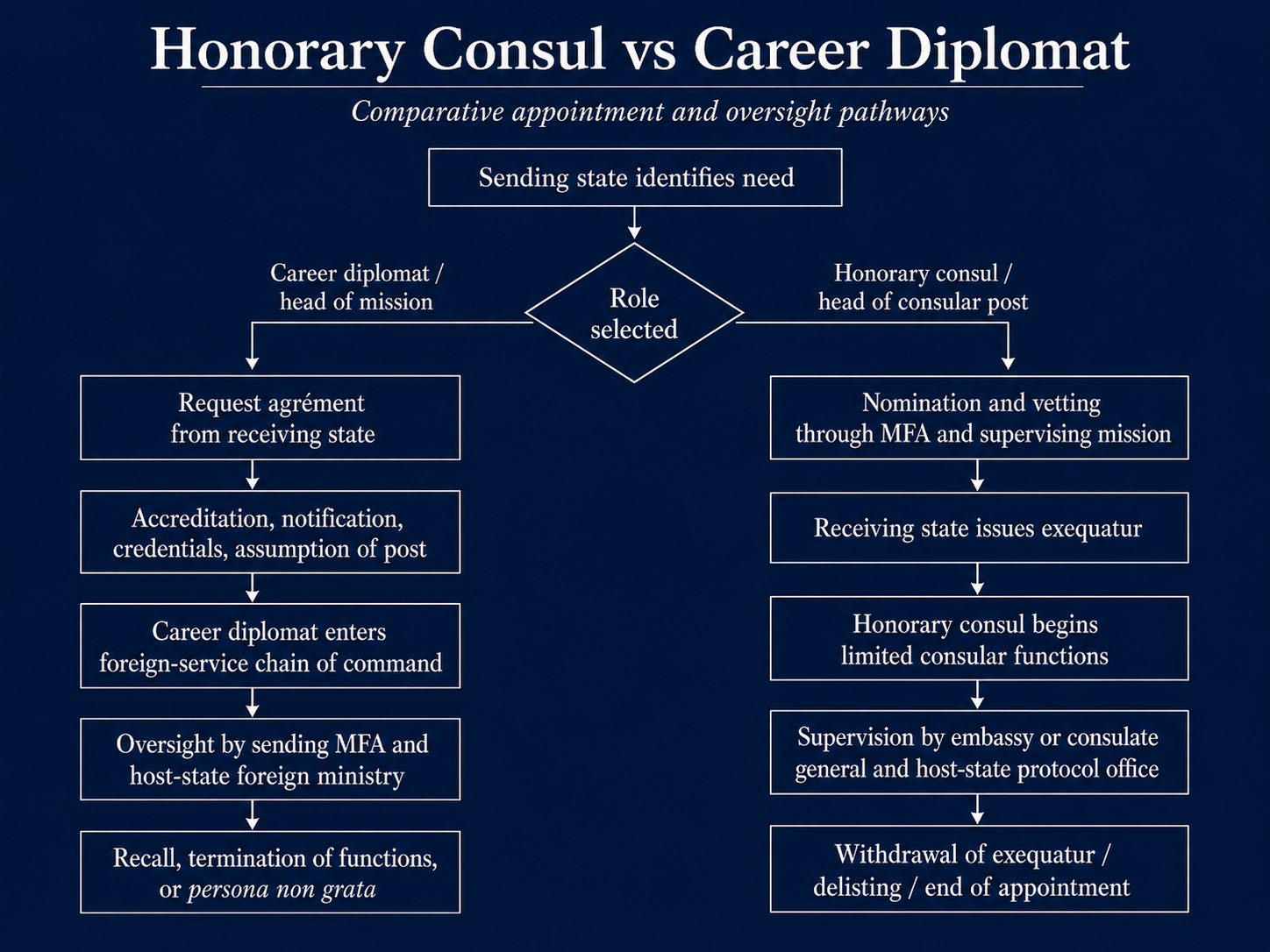
Understanding the consul vs honorary consul divide also requires clarity on the sending state vs receiving state relationship. The sending state appoints the head of a consular post and normally issues a commission or similar instrument identifying the appointment and consular district under Article 11. Admission by the receiving state is a separate step: its authorization is the exequatur under Article 12. Provisional admission is possible under Article 13. VCCR Articles 10–13 distinguish these steps; a sending-state commission must not be confused with receiving-state authorization.
Residence, nationality and local connections must be assessed against the appointment rules of both states. Under VCCR Article 22, appointment of a receiving-state national requires that state’s express consent.
Attribute
Career Diplomat
Honorary Consul
Employment Status
Full-time civil servant
Private citizen, part-time
Remuneration
Salaried by sending state
Non-salaried (may retain fees)
Appointment Instrument
Domestic appointment; credentials or notification appropriate to the role
Sending-state commission or notification; receiving-state exequatur for a head of post
Governing Framework
Vienna Convention on Diplomatic Relations (1961)
Vienna Convention on Consular Relations (1963)
Choose a career diplomat framework when full-time state representation and broad jurisdictional authority are required. The honorary consul model fits situations where a trusted local figure can serve a narrower, community-facing role without the overhead of a permanent mission.
The distinction between sending-state appointment and receiving-state admission helps explain why legal status and the scope of protection must be checked separately.
Head-to-Head Comparison: Status, Immunity, and Scope
Understanding what is an honorary consul in practical terms requires moving beyond titles into the specific legal architecture that governs each role. For ultra-high-net-worth individuals (UHNWIs) exploring non-career diplomatic advisory appointments, the distinctions below are not administrative footnotes — they carry direct consequences for asset protection, travel rights, and legal exposure.
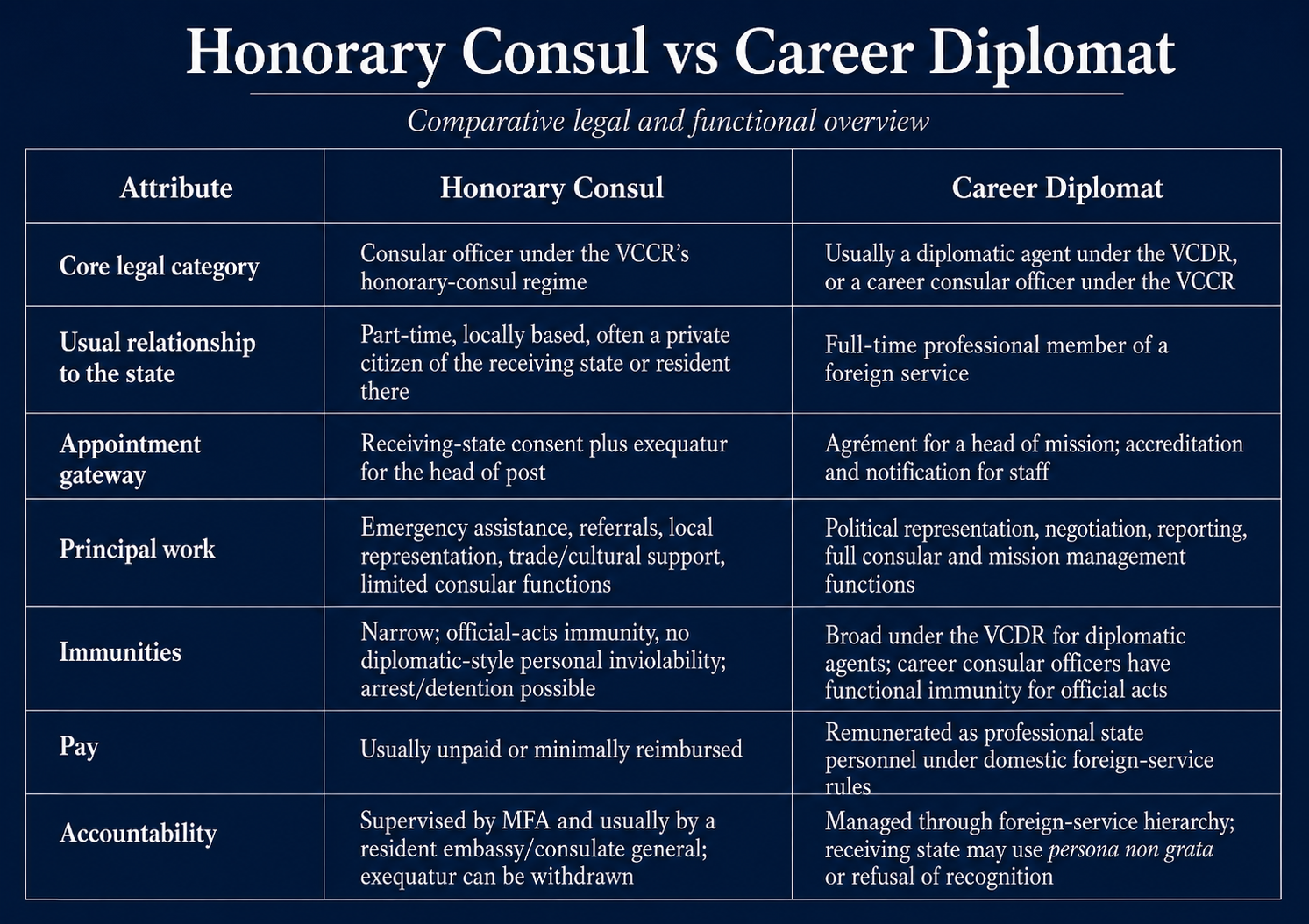
The two roles diverge sharply across four dimensions that matter most to any structured evaluation:
Feature
Career Diplomat
Honorary Consul
Immunity Level
Personal inviolability and broad jurisdictional immunity under VCDR Articles 29 and 31, subject to civil and administrative exceptions, waiver under Article 32, and the nationality/residence rules in Article 38
Immunity from jurisdiction for official consular acts under Articles 43 and 58, subject to exceptions and the nationality/residence rules in Article 71 of the Vienna Convention on Consular Relations (VCCR)
Jurisdiction
Broadly national; may represent state interests across the entire host country
Restricted to a defined consular district; the Diplo Foundation and the U.S. Department of State’s Office of Foreign Missions both confirm this geographic limitation
Passport Eligibility
Passport eligibility and official use depend on sending-state law
Not automatically entitled to a diplomatic passport — a persistent misconception; eligibility depends entirely on the appointing state’s domestic law. Review the legal criteria for diplomatic passport eligibility before making assumptions
Remuneration & Obligation
Salaried government employee with full-time professional obligations and Foreign Service requirements
Typically unpaid or nominally compensated; maintains a private profession and operates on a part-time, voluntary basis
Jurisdiction scope is a frequent blind spot. Career diplomats operate with national reach, while honorary consuls are geographically tethered to a consular district — a boundary that carries real implications for any UHNWI with assets distributed across multiple regions of a host country.
The passport misconception deserves special attention. Many candidates assume honorary appointment automatically unlocks diplomatic travel documents. In practice, that eligibility is state-specific, legally conditioned, and rarely guaranteed — making independent verification non-negotiable before structuring any appointment.
However, it is the immunity gap that most directly shapes risk exposure. The VCDR generally gives diplomatic agents broader protection than the VCCR gives honorary consuls, subject to each convention’s exceptions and nationality/residence rules — a distinction whose jurisdictional boundaries require their own dedicated analysis.
The takeaway: map each role’s protections against your actual asset footprint before treating any appointment as a shield.
Jurisdictional Analysis: The ‘Functional Immunity’ Constraint
The previous sections established the structural gap between career and honorary appointments. What that comparison doesn’t fully surface is the legal exposure that gap creates — particularly for principals whose professional and personal activities overlap across multiple jurisdictions.
Functional immunity concerns acts performed in the exercise of consular functions. VCCR Articles 43, 58, 63 and 71 must be read together. Article 58 applies Article 43 to honorary consular officers; Article 43 also contains exceptions for certain civil claims. Article 63 addresses criminal proceedings against honorary consuls. Article 71 provides a separate, narrower regime for consular officers who are nationals or permanent residents of the receiving state, unless that state grants additional privileges. None of these provisions creates a general exemption for private business conduct.
The distinction between official acts and private activity should be checked for the particular dispute and jurisdiction. A consular title alone does not establish immunity.
Dimension
Honorary Consul
Career Diplomat
Immunity Scope
Official acts only (functional)
Broad personal inviolability
Criminal Jurisdiction
Subject to receiving state law for private conduct
Immunity from receiving-state criminal jurisdiction under Article 31, subject to waiver and Article 38
Travel Document
Typically retains civilian passport — a common misconception is that honorary consuls get diplomatic passports automatically; they typically do not. For a detailed breakdown of who actually qualifies for one, legal requirements vary sharply by sending state.
Diplomatic passport issued by sending state
Host-State Citizenship Permitted
Possible with the receiving state’s express consent under VCCR Article 22
Possible with the receiving state’s consent under VCDR Article 8; Article 38 limits protection
Private Business Activities
Permitted but fully subject to local law
Private professional or commercial activity for personal profit in the receiving state is prohibited by VCDR Article 42
Jurisdictional Review Required
Prudent for complex circumstances; any legal requirement depends on applicable law
Handled institutionally by sending state
The Official Acts doctrine draws the critical line. In practice, any private business transaction — real estate holdings, investment activity, board participation — conducted by an honorary consul falls squarely under local law. The title does not create a legal firewall. For UHNWIs who hold multi-jurisdictional assets alongside a consular appointment, this distinction isn’t theoretical: a private commercial dispute does not acquire consular immunity simply because one party holds the title.
Host-state citizenship introduces further complexity. VCCR Article 22 makes appointment of a receiving-state national dependent on that state’s express consent. Article 71 then governs the protection of nationals and permanent residents. A dual-national honorary consul may simultaneously owe tax obligations, regulatory compliance, and civil liability in the same jurisdiction where they serve — without a general consular exemption for private matters; any additional protection must be established under the applicable rules.
One practical pattern among global principals is that the question of whether do honorary consuls get diplomatic passports is raised early, yet the more consequential question — how local law will treat private conduct — is often deferred until a problem arises.
For UHNWIs, jurisdictional alignment review before accepting any non-career appointment is not optional. It’s the analytical foundation that prevents a reputational asset from becoming a legal liability.
Before evaluating any honorary appointment, map every jurisdiction where private assets are held against the receiving state’s legal framework — the title protects the function, not the person.
The Bottom Line: Strategic Takeaways for the Global Principal
The comparison between career diplomats and honorary consuls ultimately resolves into a single practical question: what protection and operational value does a non-career appointment actually deliver? The answer, consistently, is that honorary consul diplomatic immunity is functional and narrow — immunity from jurisdiction generally concerns official consular acts, while the convention separately addresses other protections and exceptions.
Discussing Cyprus’s selection of honorary consuls, Euripides L. Evriviades emphasizes integrity, sound judgment, social connections and financial standing. These are selection criteria, not a legal shield. Principals who approach these appointments expecting broad immunity coverage are working from a fundamentally flawed premise.
Before any appointment moves forward, here is the decision framework that matters:
Understand the role’s actual purpose. Honorary appointments generate diplomatic access and local credibility — not personal legal protection.
Audit the sending state’s framework first. Jurisdictional rules vary significantly between states; due diligence on the sending state’s consular law is non-negotiable.
Prioritize compliance over convenience. Compliance-first advisory is the only reliable way to mitigate the structural risks that non-career appointments carry.
Verify how immunity is scoped in practice. Functional immunity applies to official acts only — understanding what a diplomatic passport legally covers helps clarify where protections begin and end.
Engage specialized jurisdictional analysis. William Blackstone Internacional provides the framework-alignment review that transforms good intentions into legally defensible positions.
The principals who navigate non-career appointments successfully are those who treat them as strategic instruments requiring rigorous legal architecture — not ceremonial titles. Structured advisory isn’t optional at this level; it’s the difference between an appointment that serves its purpose and one that creates unanticipated liability.
Before pursuing any consular appointment, commission a jurisdictional analysis — the framework always determines the outcome.Last updated: September 26, 2026


 The two roles diverge sharply across four dimensions that matter most to any structured evaluation: